Energy Efficiency in Doors and Windows
Fenêtres Concept designs and manufactures energy-efficient windows in Québec that are ENERGY STAR® certified and tailored to the Québec climate. Our products meet and exceed ENERGY STAR program requirements, resulting in better comfort year-round, reduced heat loss, and measurable energy savings.
Why this matters in Québec
- Harsh winters: reduces conductive heat loss and limits air infiltration
- Sunny summers: controls solar gain to prevent overheating
- Comfort and condensation: reduces drafts and humidity around the glass
How to read energy performance ratings
- U-factor (W/m²·K): Measures heat loss. A lower value means better insulation.
- ER (Energy Rating): A Canadian index that combines insulation, solar gains, and air leakage. A higher value means better overall efficiency.
- SHGC (Solar Heat Gain Coefficient): Fraction of solar heat transmitted, from 0 to 1. A lower value provides more solar control. A higher value allows useful heat gains in winter, especially on well-exposed façades.
- Airtightness: Quality of the seals, weatherstripping, and frame design. Good airtightness limits infiltration and improves real-world performance.
Orientation tip: On south-facing façades, favour winter solar gains. On the west side, focus on solar control in summer. On the north and east, prioritize insulation with a lower U-factor and a higher ER.
What sets Fenêtres Concept apart
- 7/8 in double glazing and 1 ¼ in triple glazing for increased insulation
- Low-E coatings that reflect infrared heat and help stabilize indoor temperatures
- Argon gas in the cavities to reduce convection and lower the U-factor
- Warm-edge spacers that cut thermal bridging and reduce condensation
- Multi-chamber PVC frames and a hybrid aluminum option with thermal break for superior durability
- Local manufacturing and quality control for consistent performance and fast service
- Warranty coverage: up to 20 years on white PVC and hardware, 10 years on aluminum components and paint, 5 years on labour, 2 years for spontaneous thermal breakage, 1 year on screens and weatherstripping, sealed units with a limited lifetime warranty
Energy values of our windows
ER ratings obtained with our combinations of Low-E glass, argon gas, and warm-edge spacers. A higher ER means better efficiency.
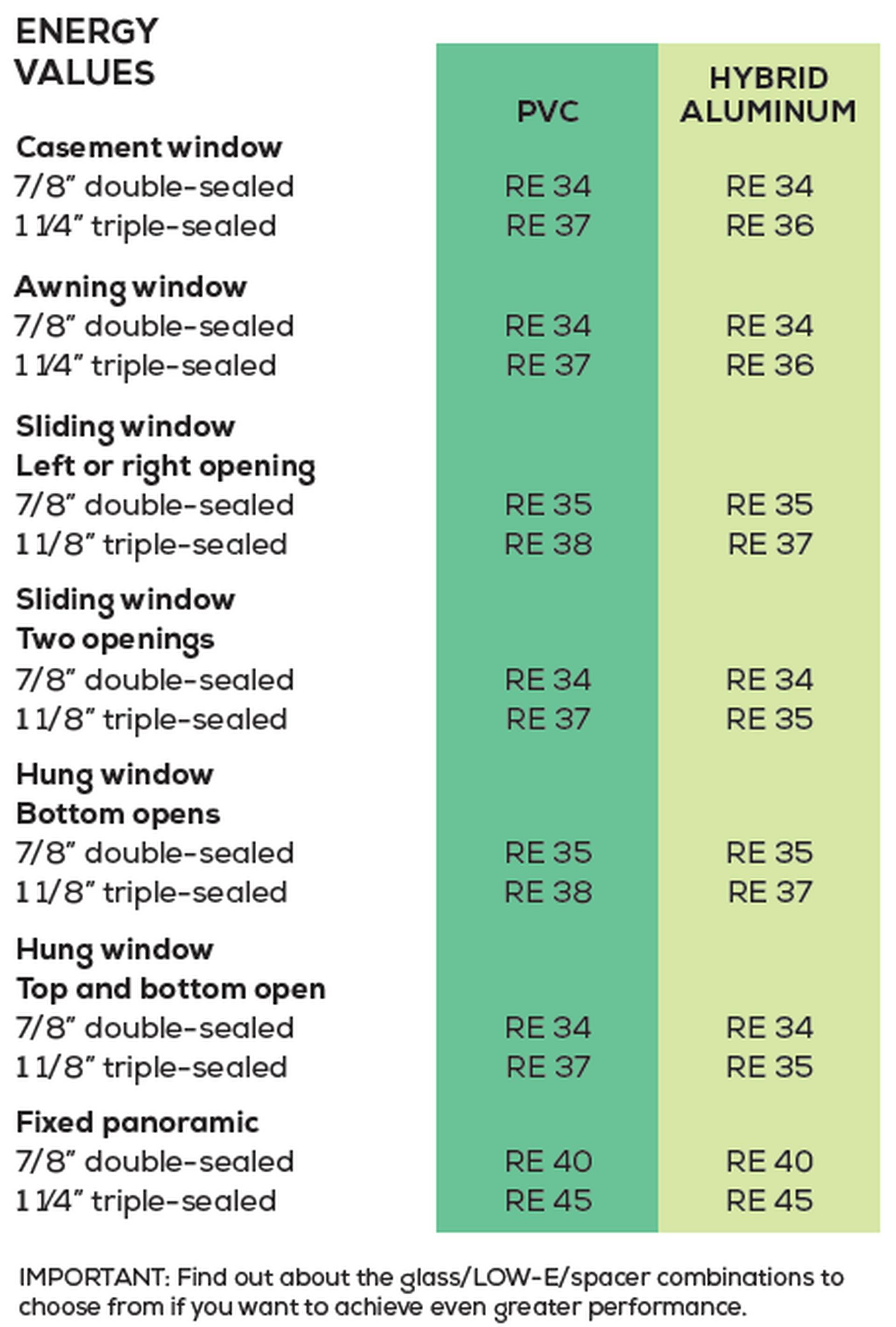
Performance tip: Ask about our combinations of glass, Low-E, argon, and spacer options to either maximize ER or further reduce the U-factor, depending on your project.
Installation and real-world performance
Installation accounts for a major share of overall performance. We recommend continuous membrane and sealant, insulating the cavity with closed-cell foam, compatible caulking, properly adjusted weatherstripping, and well-drained thresholds. We work with trained installers to preserve airtightness and durability.
FAQ
The U-factor measures heat loss. A lower value means better insulation. ER is a Canadian index that combines insulation, solar gains, and air leakage. A higher value indicates better overall efficiency.
1 ¼ in triple glazing improves insulation and comfort near the window and reduces condensation as well as noise. 7/8 in double glazing remains an excellent choice when you want a balance between budget and performance.
The low-emissivity coating reflects infrared heat. Your home stays warmer in winter and cooler in summer.
Yes. Argon reduces convection between the glass panes, which helps to lower the U-factor.
It is the component that separates the glass panes. A low-conductivity model cuts the thermal bridge, reduces condensation around the edge, and improves the durability of sealed units.
PVC offers superior insulation and excellent value for money. The hybrid aluminum option provides a very durable exterior finish with a thermal break.
Without a continuous membrane, proper sealant, and cavity insulation, even a high-performance window can allow air and moisture to pass through. Professional installation is essential to achieve the rated performance.